Custom Silicon for Inference: Why Hyperscalers Are Designing Their Own LPUs
The economics of AI change when a model moves from development into daily use. Training attracts attention because it requires spectacular computing resources. Inference creates the recurring bill: every search, generated answer, recommendation, and coding suggestion consumes computing capacity.

For a hyperscaler serving enormous volumes of requests, a small improvement in cost per useful response can justify substantial engineering investment. That is why custom inference silicon has become a strategic priority rather than a semiconductor side project.
The title uses “LPUs” broadly, but the terminology needs precision. Language Processing Unit is closely associated with Groq’s architecture. Google’s TPUs, Amazon’s Inferentia and Trainium, and Microsoft’s Maia are custom AI accelerators; they are not automatically Groq-style LPUs.
The shared motivation is control: over computing economics, deployment capacity, and the relationship between hardware and the workloads it must serve.
Inference Turns AI into an Operating-Cost Problem
Training produces or updates a model. Inference uses that model to generate predictions, classifications, recommendations, or other outputs.
A successful AI service can perform inference continuously, making efficiency relevant long after the initial model-development expense.
The business question becomes how much useful work the infrastructure delivers for its total cost.
For a cloud operator, that includes processors, memory, networking, power, cooling, software, and utilization. Custom silicon is attractive when those elements can be optimized together around workloads the company understands well.
Why Scale Changes the Build-versus-Buy Decision
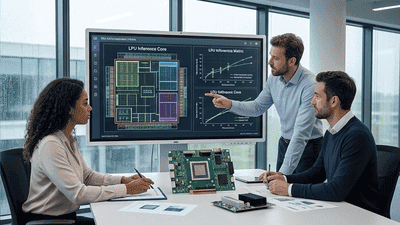
Designing a chip requires significant development spending before the first usable device arrives. Verification, manufacturing preparation, software, and system integration add to the commitment.
A smaller company may never process enough workloads to recover that investment.
A hyperscaler can distribute the cost across a large deployment and several years of operation.
Scale also provides internal workloads for evaluation. The company does not need to begin by persuading an external market to adopt an unfamiliar processor; it can start with services it already operates.
GPUs Remain Formidable Competitors
GPUs provide programmable parallel computing supported by extensive software and developer ecosystems.
That flexibility is valuable when models, operators, and deployment strategies change quickly.
A custom accelerator may offer an advantage for selected workloads without matching that breadth.
The practical decision is therefore not “GPU or custom silicon” for every application. Hyperscalers can maintain mixed fleets, using different processors where each provides suitable economics, performance, and development flexibility.
ASIC, NPU, and LPU Describe Different Things

ASIC means application-specific integrated circuit. It describes a chip designed for a particular class of functions, although many ASICs remain programmable within their intended domain.
NPU generally identifies a neural-processing accelerator. Its implementation and supported workloads vary across products.
Groq’s LPU describes a particular inference-oriented approach emphasizing compiler scheduling, deterministic execution, and on-chip memory.
These labels overlap in purpose without being interchangeable. A comparison should focus on architecture, software, and workload behavior rather than assume every inference chip follows one blueprint.
What Makes the LPU Approach Distinctive
Groq describes its LPU as a software-first, programmable assembly-line architecture with deterministic compute and networking.
The compiler plans execution and data movement, reducing reliance on the dynamic scheduling mechanisms familiar in other architectures.
Groq also emphasizes on-chip SRAM as a way to provide high-bandwidth, predictable access.
This approach illustrates how an inference-focused design can prioritize latency and execution consistency. It does not establish that hyperscalers’ own chips use identical scheduling or memory arrangements.
Predictable Execution Can Improve the User Experience

For interactive services, average response speed is only part of the experience. Users also notice pauses and unusually slow requests.
More predictable hardware execution can help reduce one source of variation.
However, chip-level determinism does not eliminate network delays, request queues, scheduling decisions, or other system effects.
For service operators, the relevant objective is consistent end-to-end performance. Architectural predictability is useful when the surrounding serving stack can preserve its benefit.
Prefill and Decode Create Different Requirements
Language-model inference commonly includes processing the input prompt and then generating output tokens.
The prompt-processing phase, often called prefill, can expose substantial parallel work. Autoregressive decoding generates subsequent tokens through a sequence of dependent steps.
The balance between computing demand and memory movement can therefore change during one request.
For chip designers, this argues against judging inference through one headline throughput figure. Prompt length, output length, concurrency, and model architecture all influence which hardware resources matter most.
Latency and Throughput Are Not the Same Goal
Latency measures how long a request or part of a request takes. Throughput measures how much work a system completes over time.
Batching requests can improve hardware utilization, but waiting to assemble a batch can add delay.
A serving operator must balance those effects against the service’s requirements.
Custom inference designs can target a specific balance. A processor optimized for responsive conversations may be evaluated differently from one handling large volumes of noninteractive classification or recommendation work.
Memory Architecture Defines the Trade-Off
AI models need access to weights and intermediate data. Moving that information can become a major constraint.
On-chip SRAM offers close, fast access, but consumes substantial chip area and provides limited capacity relative to external memory systems.
HBM supplies much larger working-memory capacity through a wide interface, while introducing package, cost, and power considerations.
Neither approach wins universally. The useful architecture depends on model size, data movement, available parallelism, and the cost of distributing work across multiple devices.
Custom Silicon Does Not Make HBM Irrelevant
Some inference accelerators place greater emphasis on SRAM. Others still rely heavily on HBM.
A custom processor can therefore remain exposed to advanced-memory availability and packaging constraints.
The buyer has changed its compute design without necessarily removing its dependence on the memory supply chain.
For infrastructure planning, the chip must be evaluated as a complete system. Reducing one bottleneck can shift pressure toward memory capacity, interconnect bandwidth, or final-package manufacturing.
Google, Amazon, and Microsoft Illustrate Different Strategies
Google’s TPU family, Amazon’s Inferentia and Trainium, and Microsoft’s Maia show that hyperscalers are pursuing first-party AI hardware through different product paths.
The categories are not perfectly divided into training-only and inference-only devices. Reporting on Amazon’s strategy, for example, describes Trainium as capable of supporting both types of workload.
That flexibility matters as deployment needs evolve.
The common thread is ownership of important design decisions. The implementation remains company-specific, reflecting each operator’s workloads, software, infrastructure, and commercial priorities.
The Compiler Is Part of the Product
A specialized chip cannot deliver its intended value if models are mapped inefficiently onto it.
The compiler must translate computations into supported operations, organize data movement, and use available resources effectively.
Runtime software must then manage execution within the serving environment.
Groq’s architecture makes the compiler’s role particularly explicit: predictable execution supports advance scheduling of instructions and movement through the system. That is an architectural choice, not merely an optional software optimization.
Software Portability Determines Adoption Speed
Developers need more than theoretical chip performance. They need supported models, useful tools, debugging capabilities, and a manageable deployment process.
A migration that requires extensive rewriting can erase part of the hardware advantage.
Conversely, effective integration with established frameworks can make specialized hardware easier to adopt.
For hyperscalers, software is therefore a strategic investment. The goal is to make custom silicon accessible as a reliable service, rather than ask every customer to become an expert in the underlying architecture.
The Right Metric Is Cost per Qualified Outcome
Peak arithmetic performance does not establish serving economics.
A useful comparison needs model quality, precision, latency targets, workload size, and utilization held appropriately consistent.
Lower precision can improve efficiency, but any quality trade-off must remain acceptable for the application.
For operators, the decisive metric is cost per useful result under the service’s requirements. A cheaper token is not an improvement if it arrives too late, fails the quality threshold, or requires expensive additional processing.
Utilization Can Matter More Than Chip Specifications
A highly efficient accelerator provides limited financial value while idle.
Serving demand varies, and capacity must often accommodate peaks or maintain response-time targets.
Scheduling, model placement, and the ability to share infrastructure influence how much useful work the fleet performs.
Hyperscalers have an advantage here because they can coordinate hardware with their operating environment. Yet they still need enough suitable workloads to use the specialized capacity economically.
Supply Control Is a Second Motivation
Custom silicon can give a cloud operator another route to computing capacity and reduce exclusive dependence on a merchant accelerator supplier.
It can also improve the operator’s negotiating position by creating a credible alternative.
But designing a chip does not mean owning the entire supply chain.
Foundries, memory manufacturers, packaging providers, and equipment suppliers remain essential. First-party silicon diversifies dependency; it does not eliminate manufacturing constraints.
Ownership Can Deepen Cloud Lock-In
When a processor is closely integrated with a cloud’s software and services, customers may receive attractive performance or pricing within that environment.
They may also face additional migration work if they later move to another platform.
The same specialization that improves efficiency can reduce portability.
For customers, the trade-off deserves explicit evaluation. Near-term savings should be considered alongside model compatibility, operational flexibility, and the cost of changing providers.
Model Evolution Is the Biggest Design Risk
Chip development takes time. AI workloads can change before a design reaches broad deployment.
New model architectures, longer contexts, different precision requirements, and revised serving techniques can alter the resource balance.
An overly narrow design may become less useful than expected.
That is why custom silicon still needs programmability and a capable software stack. The objective is selective specialization around durable requirements, not a hardware snapshot of one model that may soon be replaced.
How to Judge a Custom Inference Platform
The strongest comparisons connect architecture with real operating conditions.
- Identify the supported models and numerical formats.
- Measure latency and throughput separately.
- Compare equivalent quality and service requirements.
- Include memory, networking, power, and software costs.
- Assess utilization across realistic demand patterns.
- Review migration effort and developer tooling.
- Check supply availability and production maturity.
- Distinguish chip benchmarks from deployed-system results.
These questions reveal whether a design advantage becomes an operational advantage.
A More Diverse Computing Fleet
Hyperscalers are designing custom inference silicon because recurring AI demand makes hardware efficiency strategically valuable. Large deployment volumes allow them to justify investments that would be difficult for smaller operators.
But their products are not all LPUs, and specialized silicon is not a universal replacement for GPUs.
The likely outcome is a more diverse fleet: flexible processors for changing workloads, tailored accelerators for established services, and software that routes work intelligently between them. The winning design is the one that delivers useful results predictably and economically—not the one with the most fashionable acronym.